
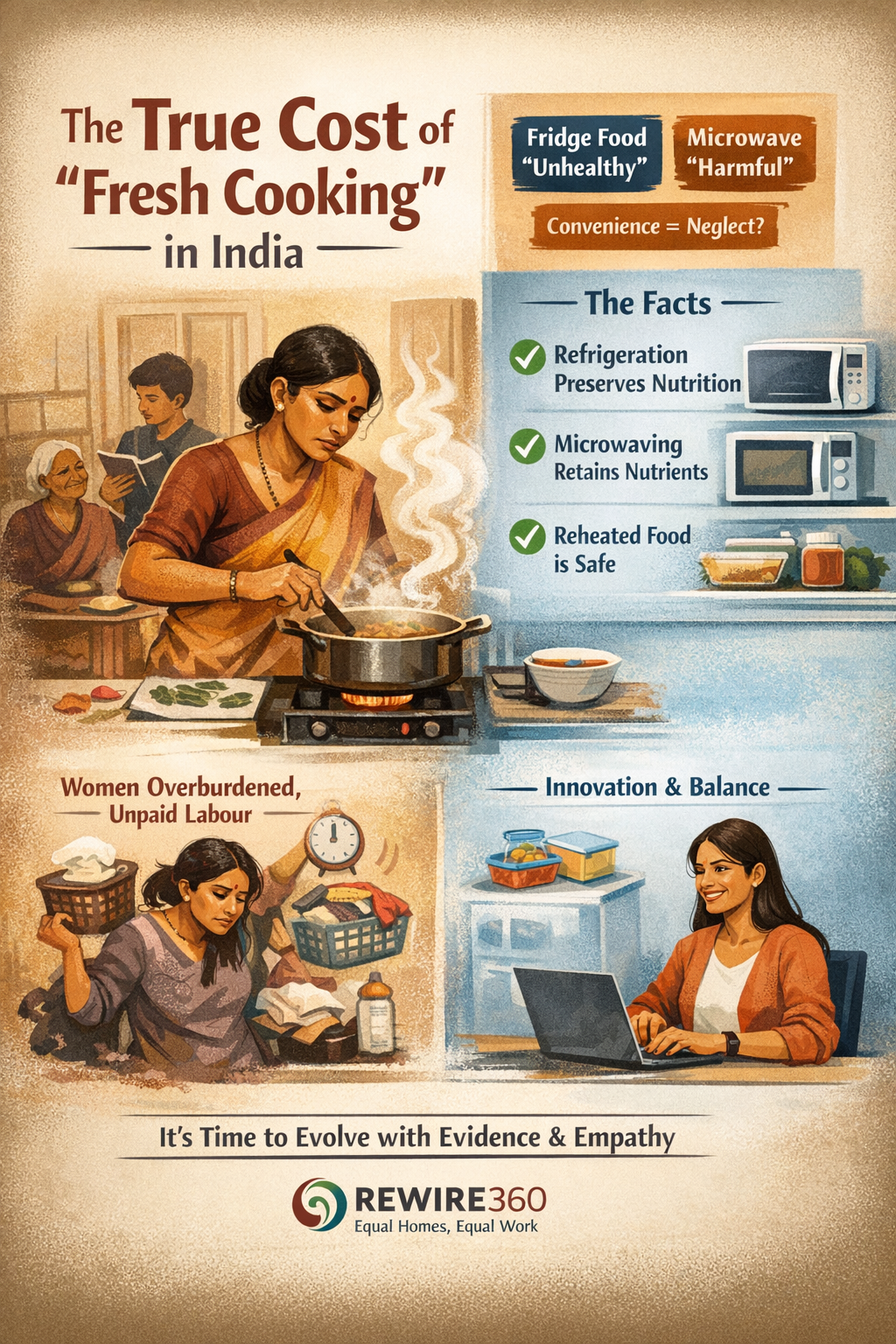
In India, cooking fresh food every day is seen as care, love, and responsibility.
But we rarely ask who pays the cost of this obsession.
Despite technology transforming every part of our lives, our kitchens remain bound to age-old expectations — largely placed on women.
In many Indian homes:
• Food stored in the fridge is seen as “unhealthy”
• Food reheated in an oven or microwave is viewed as harmful
• Convenience is equated with neglect
But here’s what evidence actually says:
✔ Refrigeration slows bacterial growth and preserves nutrition
(WHO & FSSAI guidelines)
✔ Microwaving does not destroy nutrients — in fact, shorter cooking times often retain more vitamins
(Harvard Health, WHO)
✔ Reheated food is safe when stored and handled correctly
The fear isn’t scientific.
It’s cultural — and it falls disproportionately on women.
In India, women spend nearly 7x more time on unpaid domestic and cooking work than men (Time Use Survey, Government of India).
Meanwhile, in many other countries:
• Meal prep is normal
• Frozen and stored foods are accepted
• Kitchen technology is seen as support — not a value compromise
The real cost of rejecting innovation at home is not tradition.
It’s women’s time, health, careers, and mental bandwidth.
This isn’t about abandoning culture.
It’s about evolving it with evidence and empathy.
At Rewire360, we see this clearly —
Workplace equality cannot succeed if homes continue to run on unpaid, unquestioned female labour.


Leave A Comment